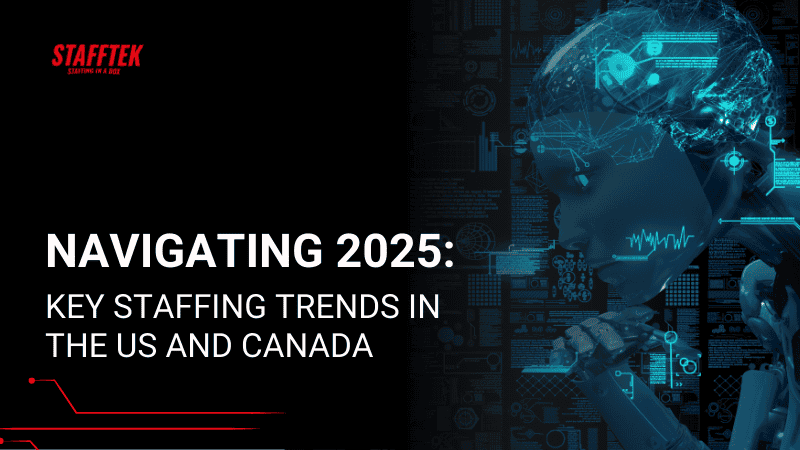
As we progress through 2025, the staffing landscape in the US and Canada is undergoing significant transformations. Understanding these trends is crucial for businesses aiming to attract and retain top talent.
1. Embracing Artificial Intelligence (AI) in Recruitment
The integration of AI into recruitment processes is streamlining hiring and enhancing decision-making. AI tools are automating tasks such as resume screening and candidate matching, allowing recruiters to focus on strategic aspects of talent acquisition. This shift is leading to more efficient and objective hiring practices.
2. Addressing Labor Shortages and Skills Gaps
Both the US and Canada are experiencing labor shortages and skills mismatches, particularly in sectors like technology and healthcare. Employers are expanding their search to include underutilized talent pools, such as veterans and individuals with disabilities, to bridge these gaps. Additionally, there is a growing emphasis on upskilling and reskilling programs to equip the existing workforce with the necessary competencies to meet evolving job requirements.
3. Adapting to Remote and Hybrid Work Models
The persistence of remote and hybrid work models is reshaping staffing strategies. Employers are investing in technologies and policies that support flexible work arrangements, recognizing the need to accommodate diverse employee preferences and maintain productivity. This trend is also expanding the talent pool, as geographic location becomes less of a constraint in hiring decisions.
4. Navigating Political and Economic Uncertainties
Political changes, such as the recent U.S. presidential transition, are introducing uncertainties that impact hiring decisions. Employers are exercising caution, delaying staffing for strategic projects until there is more clarity. Staying informed about policy developments and maintaining flexibility in staffing plans are essential for navigating this dynamic environment.
5. Fostering Diversity, Equity, and Inclusion (DEI)
There is a renewed focus on DEI initiatives within organizations. Employers are implementing strategies to create inclusive workplaces that value diverse perspectives. This commitment not only enhances company culture but also drives innovation and improves employee satisfaction.
6. Leveraging Data Analytics for Strategic Hiring
Data-driven decision-making is becoming integral to recruitment. Employers are utilizing analytics to identify hiring trends, predict future staffing needs, and assess the effectiveness of recruitment strategies. This approach enables more informed and proactive talent acquisition efforts.
In conclusion, the staffing landscape in the US and Canada is poised for significant transformation in 2025. Businesses are increasingly adopting AI-driven recruitment processes to enhance efficiency and objectivity. However, challenges such as labor shortages and skills mismatches persist, particularly in sectors like technology and healthcare. To address these issues, companies are tapping into underutilized talent pools and investing in upskilling and reskilling initiatives. The continued prevalence of remote and hybrid work models necessitates that organizations adapt their staffing strategies to accommodate flexible work arrangements. Additionally, political and economic uncertainties require businesses to remain agile and informed. A renewed focus on diversity, equity, and inclusion is reshaping workplace cultures, while data analytics are becoming integral to strategic hiring decisions. By staying attuned to these trends, businesses can develop effective staffing strategies that align with the evolving employment landscape in 2025.
Whether it’s web design, search, IT, payroll funding, sales systems, or staffing innovation, discover how StaffTek can fuel your next phase of scale.
Loren ipsum dolor sit amet, quod omnesque sea te. Qui latine fabellas ad, fastidii scaevola instructior ad est. Malorum democritum duo ea, usu sale viris insolens no, cu probo semper tamquam sea. Ex assum officiis omittantur vel, docendi corpora sed in. Erant clita dictas sea ex, prima quodsi postulant ad usu. Mucius incorrupte duo an, qui exerci recteque reformidans in.